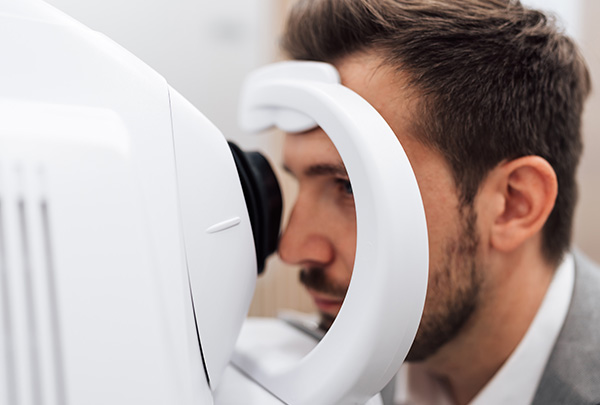
Glaucoma is an ocular disease which damages the optic nerve and results in peripheral field loss. Glaucoma is a progressive disease which for the most part worsens gradually; however any peripheral field loss is permanent. Here at Advanced Vision Optometry, we want to screen for glaucoma annually and further screen patients who may have any increased risks or changes noted in their eye health.
Types of Glaucoma
There are many types of Glaucoma:
- Primary Open-Angle Glaucoma (POAG)
- Angle-Closure Glaucoma
- Normal-Tension Glaucoma (NTG)
- Secondary Glaucoma
- Congenital (Pediatric) Glaucoma
Risk Factor Assessment
Dr. Wu will begin by assessing your risk level for developing glaucoma. This will help determine the frequency and extent of testing needed. Through a family history and medical questionnaire, Dr. Wu is looking for the following risk factors:
- Over the age of 60
- Ethnic background such as African or black Caribbean descent, Hispanic, or Asian
- Family history of glaucoma, such as a sibling or parent with glaucoma
- History of eye conditions, injuries or surgeries
- Prolonged corticosteroid use (eye drops, pills, inhalers or creams)
- Chronic conditions that affect blood flow, such as migraines, diabetes, low bloodpressure or hypertension
- Current or former smoker
Dr. Wu will also consider these risk factors:
- Eye pressure higher than normal (above 21 mmHg)
- Thin corneas (less than 0.5 millimeters)
Your prescription is also important and a factor in assessing the risk of glaucoma. People with farsightedness are at a higher risk for narrow-angle glaucoma, a more serious type that can advance quickly. People with nearsightedness are generally associated with open-angle glaucoma, which progresses slowly without any symptoms.
Standard Glaucoma Tests
During your comprehensive examination, if there seems to be a higher risk for glaucoma, Dr. Wu may suggest you come in for a glaucoma workup. A proper diagnosis requires careful evaluation of many aspects of your eye’s health – from eye pressure to corneal thickness to the health of your optic nerve.
The following two tests are always checked during a comprehensive eye examination, regardless of the risk level. This provides a baseline for comparison as you age.
Tonometry
Tonometry measures the pressure within your eye (intraocular pressure). Eye pressure is unique to each person, and the range for normal eye pressure is 12-21 mmHg (“mmHg” is millimeters of mercury, a scale for recording eye pressure). Most glaucoma cases are diagnosed with pressures over 20 mmHg; however, Low Tension Glaucoma is also a type of glaucoma in some patients, where there is still peripheral field loss even with normal eye pressures.
Ophthalmoscopy
This is an examination of your optic nerve. Based on the results, Dr. Wu may ask you to come back for more glaucoma tests.
Supplemental Glaucoma Tests
Perimetry
Perimetry is a visual field test. It creates a map of your complete field of vision. During this test, which is done one eye at a time, you will look straight ahead and then indicate when you see a light in your peripheral (or side) vision. Try to relax and respond as accurately as possible. To ensure accuracy, our technician may repeat the test to see if the results are the same the subsequent time. If you have been diagnosed with glaucoma, a visual field test is usually recommended at least once per year to assess changes to your vision.
Gonioscopy
This diagnostic test helps determine the angle between your iris and cornea. Angle-Closure Glaucoma can occur if the angle is too narrow, causing a build up of eye pressure in your eye.
Pachymetry
Pachymetry measures the thickness of your cornea, the clear window in front of the eye. Corneal thickness has the potential to influence eye pressure readings.
Because glaucoma is a progressive disease, a glaucoma diagnosis relies on many different measurements and tests over time. Be sure to have regular eye examinations, especially if you have any of the risk factors, to detect glaucoma early.